Wednesday, 4 December 2013

Conservation Case Study: The Dining Room "Meshed" Rug

Quite a few years ago, Parkwood was used as the location for a carpet cleaning commercial. The commercial, for a spray and rub product, featured the library of Parkwood, as a museum, where a famous document was signed, but not before the quill and ink hit the carpet c. pretend 1775, leaving a historically significant stain. Forward to faux museum film set 2004 where the commercial continues, having the famous stain be removed by a new over zealous faux museum employee using the featured product.
While the commercial was humorous, leaving the featured product looking marvellously effective, it was just a commercial.

This past summer Parkwood was the location for another production shoot. Due to a mishap the artefact dining room carpet ended up with a very dark brown oil based (Min Wax Liquid) stain that saturated the fibres of the 300 year old Meshed Persian rug. A vibrant blue with red undertones, typical of meshed rugs, the intricate patterns were all but a brown blob in the 2ft x 2ft area of the stain. Contrary to the commercial shot on location in 2004, we did not turn to the spray and rub product nor the steam cleaning approach. In preservation our methods are strictly the safest and non damaging, non structural altering approach and this often means that we only use the most inert and non chemically developed methods.

The first concern with our freshly stained Persian rug was the physical strength of the carpet fibres. As mentioned, the carpet is 300 years old and while in amazing condition for its age, has seen many feet walk across it. The strength of the warp and the weft and its endurance under mechanical forces of cleaning were a concern. Our meshed rug is composed of cotton warp threads and wool weft fibres, each organic product, having its own personality and attraction/retention elements with regards to the stain.

The first step in the treatment program was to try and remove as much of the dark brown Min Wax oil-based stain, as we could see. This process was an application of a very gentle soap ( horse soap) called Orvus Paste. The best friend to many museum functions, Orvus is one of the most gentle products on the market, several times more gentle then Ivory Soap for the lay person.  Hours after the initial spill were spent just mopping up the surface stains, while ensuring that Parkwood staff were not manipulating the original blue and red vegetable dye hues that were used to colour the carpet in Iran 300 years prior.

The next step was the professional conservator visit. Fine Art Object Conservator, Miriam, was on site the following day and began her evaluation of the stain and the condition of the rug. Miriam further analysed the warp and the weft structure and its physical integrity for enduring the next steps. The stain removal process meant that the rug would be saturated for many hours with blotting techniques applied, and could the fibres, seen to the right, withstand the pressures of the cumulative blotting.

The curatorial decision was to proceed with the initial treatment, with the understanding that should an area of loss occur (aka a hole) the conservator would be dying threads and reweaving into the historic warp and weft pattern.

The treatment process continued with an eyedropper application of the conservation solution applied to the stain with precision grid like accuracy and then blot. Imagine the hours of tedium application that this involved. An eye drop of solution to a 5cm area, blot, continue.


Application of the poultice

After about 80 hours of solution application and blotting, we moved onto the next stage of our treatment. The poultice stage. The idea of the poultice was that as the clay dries, it helps draw any remaining brown colour from the rug fibres.

We have completed about 30 hours of poultice application, drying and removal, followed by reapplication. This week has seen us reweave some of the rug fibres that have loosened over the weeks of treatment, and after drawing the residue brown Min Wax stain through the poultice, we are back to the eye dropper solution treatment and blotting procedures.  The end of this week will see 120 hours of work applied over the last weeks and months to the carpet. During the hours spent kneeling over the stain, from the curatorial perspective, I almost wish that the 2004 commercial for the spray and rub product was indeed true.


Thursday, 7 November 2013

The Bugle Call to Action

On the library desk that RSM would work from in the evenings, I interpret several books. Two of them are by John Buchan, Lord Tweedsmuir, who was great friends of the McLaughlin Family, growing to know them very well during his time as Canada's Governor General. The other is RSM's daily diary, a gift from the British Empire Service League.  These little gems within our extensive collection will often go unobserved in a room as marvellous as the library, when one is trying to take in everything the space has to offer when visiting.

In recent months, I have written about Oliver Hezzelwood and his poems. Since locating the book of poems and learning more about Oliver, I have added the volume to the contents of the desk. While browsing through the book of poems I found the following entitled The Bugle Call to Action, a fitting tribute for the ceremonies and remembrances for the coming days ahead.


Prior to the poem, Oliver comments on the statue which inspired him, along with his service, to write this poem. He is very moved by the full-sized statue of a war horse,
"The Last Call" by CB Birch, which he had seen exhibited at the Crystal Palace, London. (lost to fire in 1936)


"Now once again the war drums roll,
Again the bugles call,
Again grim death demands its toll,
And myriad heroes fall.
 
Again the humanity is crushed
Beneath a despot's heel;
Again the voice of laughter's hushed,
The nations backward reel.
 
Again the valiant seize the sword,
The crowded seeks the night;
Again the wail or woe is heard
And childhood shrinks in fright;
 
Again in discipline we pass
Beneath the chastening rod;
Again the skies seem triple brass
When we appeal to God.
 
And now to us peals out the blast
"For country, home and God!"
And tread the road they trod."
 
 
Lest We Forget

Friday, 25 October 2013

Parkwood Servants' Reunions

When I arrived at Parkwood 13 years ago, I was surprised at how little the modern Parkwood museum family knew about the people who worked at the Estate over the years for the McLaughlins'. The archival holdings had omitted these people, the tour script referenced service staff, but that was all we knew. As someone passionate about social history, I wanted to know their names, the uniforms, the household rules, pay rates, etc. I guess I can be called nosy, I prefer curious.

In 2000, I set about collecting the oral histories of the staff we knew of. We posted press releases to discover/locate people that were out there and we didn't know. We asked for the living memories that were in the community and collected and collected. True to any oral history collecting project, people were wary of what we were up too.
"What do you want to know and why?"  "What are you using the information for?"  "I don't want to be videotaped or recorded."


We struck a committee, received training on collecting skills, and ethics around collecting oral histories and set about trying to find secondary sources of information to reinforce many of the stories/memories that we were hearing during the interview process.

(As an aside, researchers and historians have many reasons to be very wary of memories. Think about your own memories, and what is true to pure memory or what has been coloured over the years or influenced by life, photographs, suggestions. Multiply those outside influences by time, by decades. That is what I mean when I say that we need to reinforce the stories/memories being related to us in an oral history interview.)


Regardless of that aside, one of the successes we have had in collecting the oral histories of the former McLaughlin staff is the reunions we try and hold on annual basis. What a marvellous venture that has become. Former staff, from varying decades, reminiscing, and sometimes reuniting after 60 years, has proven to be one of the most remarkable experiences I have had at Parkwood. Tales of broken curfews; scoldings in the kitchen from a tired and stressed cook; lemonade arriving on trays in the Sunken Garden on a hot August day; the way the cold frames were designed and where they were situated on the property; have all proven to be valuable assets, even though the "tellers" think that we would find them mundane and useless. To the contrary. The fact that I can still pick up the phone and ask former staff about the brick foundation being painted or not painted in the greenhouse c.1960 and they can reference the stain colour on the floral benches is an amazing tool that I have to keep reminding myself is a rare privilege for a curator, and one that is finite.
 
Although, the fact that one day I shall not have the access to the Parkwood past through living resources, I still relish the fact that as I plan a reunion in the near future, I am very fortunate and looking forward to seeing my living artefacts ( though I suspect they may not find that reference as loving & genuine as I do!)


Tuesday, 17 September 2013

The enduring appeal of Gracie Fields at Parkwood

The Parkwood staff has always known that Gracie Fields was a visitor of the McLaughlin Family. During WWII, Sam McLaughlin had solicited her help to narrate a National Film Board mini -movie that he produced to assist the Canadian Red Cross with its homefront campaign efforts. We also knew that in November 1941 she and Adolphe Menjou were guests at the Estate as part of the General Motors War Bonds campaign. Throughout our programs and events, where we tell the Parkwood Second World War story, Gracie has always been a figure of our interpretation.
Gracie Fields, ALM, Billie Mann,RSM


For those of you who follow our blog, Twitter and Facebook accounts, you understand that we are always discovering new gems among our artefacts and archives collections. Today is a 1941 Toronto Star article about the Chrysanthemum Tea and Mr. McLaughlin supporting the Sailors' Christmas Fund of the Navy League entitled; "Parkwood" Thrown Open in Aide of Sailors' Fund. Col., Mrs. R.S. McLaughlin Hosts to Hundreds- Gracie Fields Speaks to Guests ,   "co-operating with the Navy League in its efforts to cheer and comfort Canada's merchant seamen and sailors, Colonel R.S McLaughlin, honorary president, Ontario, has accepted the honorary treasurership of the Sailors' Christmas Fund.......may provide Christmas cheer for the thousands of sailors who will be far from home and loved ones."
Miss Jean Mowbray, guest at tea

The article continues to describe the décor, the chrysanthemums, and the fitting menu of seafood and lobster. It also describes what the Navy League will do with the monies raised by the McLaughlin event where donations are actively collected among the 600 guests attending the tea and flower show.
"The league will give Christmas dinner, cigarettes, entertainment, woollens, and other comforts from the Sailors' Christmas Fund."

The big dollar philanthropy of the McLaughlin Family is well documented. The Parkwood staff continue to find examples of McLaughlin community spirit, both local and national, which is important to ensure that the McLaughlin legacy and story doesn't disappear from our collective memories.

Friday, 13 September 2013

Honouring R.S. McLaughlin and his legacy with the Parkwood Promenade


Each September the Ontario Regiment (RCAC) celebrates its birthday (147 years in 2013), along with honouring Sam McLaughlin's birthday with the Parkwood Promenade.


The relationship between the regiment and Parkwood has been a lengthy one, with R.S. McLaughlin being the patron of the regiment's band for many decades, funding the purchase of the band's instruments and uniforms during these
years, and financing the building of band shell at Oshawa's Memorial Park to provide the bandsmen with their own venue to entertain Oshawa's citizens.

R.S McLaughlin was appointed honorary lieutenant-colonel of the 34th Ontario Regiment in 1921 and held this position until 1931, at which time he was appointed honourary colonel of same unit, renamed the Ontario Regiment (RCAC), a reserve armoured regiment based in Oshawa. Affectionately known as "Colonel Sam," McLaughlin served as honorary colonel until 1967, earning the distinction as the longest continuously serving colonel in the history of the Canadian Forces.

After R.S.M died, son-in-law, Major-General C. C. Mann (ret'd) became honourary colonel of the regiment from 1973-1975. Followed by his wife, honourary colonel, E.V. (Billie) McLaughlin Mann from 1983 until her death in 1993. 
C.C. Mann & Billie McLaughlin- wedding day 1930 at Parkwood


The Ontario Regiment will once again celebrate its shared history with Parkwood on Sunday afternoon with their promenade program, highlighted with a Change of Command Team Parade.


R.S. McLaughlin would be pleased to see
that the legacy continues.

Thursday, 15 August 2013

Oliver Hezzelwood

I had a call from a researcher yesterday asking about Oliver Hezzelwood. Research calls are not unusual. We field about one enquiry regarding research each day, and they are usually automobile related, a person with a serial number asking about where and when a vintage car was manufactured. I cannot answer these questions for them, but hope that I can at least assist them in the right direction to find the answer.

The call yesterday was one that delighted me. A researcher, who had come across the name Oliver Hezzelwood during a WWI-era History class at Ryerson University last autumn called to verify the Hezzelwood relationship with the McLaughlin Family and see if I could enlighten him any further about his life and times. Through our discussions, we had the similar knowledge base on who Oliver Hezzelwood was. We knew that Oliver was an investor with the McLaughlin Motorcar Company, he lived in Toronto, at 192 Lowther Avenue. He was present at the deal the McLaughlin Brothers and Durant secured for the 15 year Buick engine negotiations in1907, he called himself a friend of Robert McLaughlin (Sam's dad). He ran for provincial politics, as one of the "prohibition" candidates (he lost); he gave up the motor car business in 1914 when the war broke out, becoming an army captain and he wrote poetry, along with publishing other books. I decided to browse the Parkwood Library book list, and what did I find, Poems and a Play by Oliver Hezzelwood, 1926, and as I browsed through  the red book cloth bound book of poems, many of them dedicated to his time in the trenches, the following poem on page 114 caught my eye, "The Building of the Motor Car"  dedicated to the McLaughlin Motor Car Company.


Thursday, 2 May 2013

Conservation Case Study: The Bowling Alley


Over the years the Parkwood Bowling Alley has been used to store and exhibit examples of the carriages and cutters from the McLaughlin Carriage Company, as well as played host to the tour admissions desk and gift shop cash. Due to these multiple uses, including fifty five years of bowling games, the bowling lane was showing its age and some strong wear patterns.
Parkwood has previously worked with Mr.Sandless on several projects, including the Business Office and the Parkwood Lodge, and during one of his visits, Tom had suggested that Mr.Sandless could take a look at the Bowling Alley and assist with its preservation. Mr. Sandless was very aware that as a National Historic Site, some of the aging that resulted due to use during the family years, was precious to us, and the wear was authentic to our interpretation program, it tells the story of the McLaughlin Family at play.
What Parkwood was concerned about was the wear that had been caused due to our commercial use of the space, the gift shop, and admissions desk, the daily museum role in its deterioration. In 2013, most of the carriages and cutters that were exhibited along the bowling alley found a permanent home at the Oshawa Community Museum, in the drive shed facility, where the story of the McLaughlin Carriage Works is interpreted. With the removal of these artefacts from the space, Mr. Sandless was able to view the entire bowling alley and propose the work that was completed May 1, 2013.


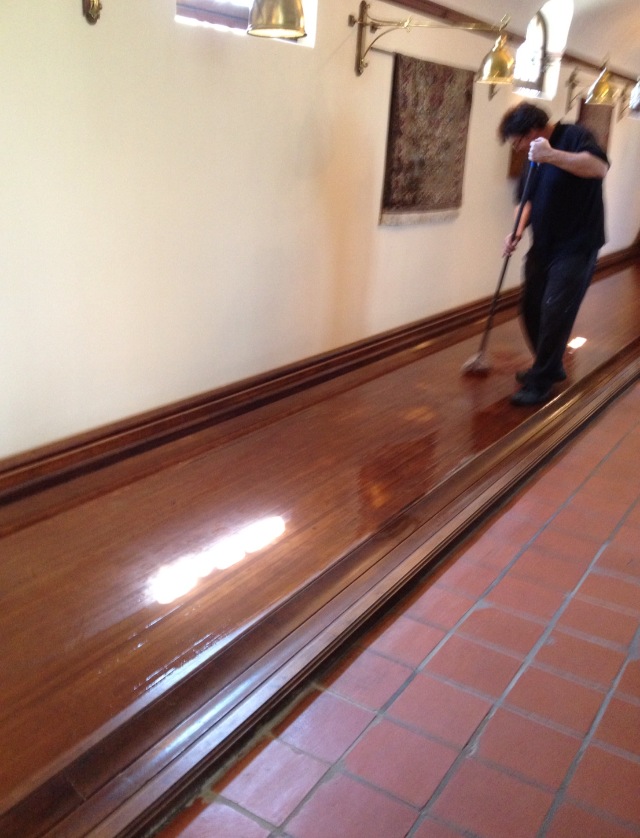
The first step was the application of the wash solution. This very mild solution removed the surface dirts and grease. It also removed previous attempts at fixing with various stain applications over the decades. The wash solution application prepares the wood grain, enabling it to be ready to accept the next stage of the treatment.


The second step was the application of the renewal product that helps invigorate the original colours of the wood, a spa treatment for the bowling alley. Notice in the photo of Tom applying the renewing solution the contrast that this step is already showing in the revitilization of the wood. 


The final step, between the drying cycles was the application of the varnish. After the renewal product was applied, most private households would have Mr. Sandless restore their wooden floors, with an application of stain. This was not the process of the bowling alley, because, remember those wear patterns that we love so much, the patina of historic use, Parkwood still wanted those. So, Tom, understanding our concerns and the need to keep the evidence of the alley being one of family use, followed our wishes and applied the varnish, as he is in the photo to the left.


  Voila, the final product!


Thank you Mr.Sandless for a remarkable job on making the Bowling Alley gleam again!

www.mrsandless.com
 

Friday, 8 February 2013


Conserving the heritage landscape – Tree Management

Severe windstorms over the last six months have caused damage and destruction of aged trees at Parkwood.  Grounds Foreman Brad Beer and Curator Samantha George recently grappled with various tree issues, and with the advice of City of Oshawa Forestry Supervisor Rob Fennell, have identified Parkwood’s  TOP TEN TREE PROJECTS.

Parkwood has some incredible trees, many of which were already here when Sam McLaughlin purchased the property in 1915 to build his dream home.  Working with top garden designers over the next 20 years Sam and his wife Adelaide then planted many more trees – to achieve the complex compositions and layered views we enjoy today.  Most have reached a venerable age and beauty that you just can’t find elsewhere.

Sadly, like us, trees can age gracefully or quickly lose their looks and faculties, move into a slow or a rapid decline.  The plug must be pulled at some point.

Trees are part of Parkwood’s overall heritage conservation, an interesting and challenging process that includes:

Collections Management & Curatorial

Trees are considered in the same way that the mansion, furnishings and archives are - catalogued, monitored, with threats identified and addressed if possible through conservation “spa” treatment.  Trees are researched individually and as part of the design, social and family histories of Parkwood, for interpretation and educational purposes (eg. tree walks, garden tours, lectures, future virtual).  

Evaluation/Assessment

Trees are assessed with regard to overall health and appearance.  Treatments are devised to improve health and increase life-span (root feeding, pruning/thinning, cabling, pest management)

Risk assessment is an important factor, to ensure the safety of garden visitors, staff and volunteers.

Removal becomes necessary at some point, and planned according to urgency and equipment access.  Late winter often provides the best opportunity for tree work, with frozen ground and leafless trees.
 
Replacement

Research and site assessment is undertaken to determine if replacement is desired or possible.  Heritage conservation dictates replacing like with like, which is always our preference but not always possible.

The replacement trees are chosen by species are size, taking into account the location, season, time frame to do the work, and equipment access (eg. tree spade or truck) and of course COST!

Site preparation is undertaken to provide the best head start for new trees.

Funding Tree Management

It’s always a challenge to find the operating and capital support needed, with so many heritage resources and competing priorities at Parkwood.   Effective tree management requires a sustained effort, which isn’t always possible.  Parkwood is grateful for individuals and businesses who provide generous assistance.

 
Tribute/memorial planting

Generally, Parkwood plants trees strictly within the context of historic replacement.  We maintain lists of historic varieties/priorities for replacement, to respond to donor requests to plant trees to mark occasions or in tribute/memorial.

Once in a while a unique opportunity arises.  In 2011 Finance Minister Jim Flaherty and Landscape Ontario planted a native maple tree, the first tree planted to mark the first National Tree Day in Canada.  This took place in a non-historic space (altered in the 1970’s for the parking garage), so was a happy exception.  Do try this at home!  The next National Tree Day is Sept 25, 2013.   

Tree Selection process

Parkwood adheres to landscape conservation principles of the Standards and Guidelines for the Conservation of Historic Places in Canada, which address land patterns, landforms, spatial organization, vegetation, viewscapes, circulation, water features, built features.  Many of these guide or inform tree replacement selection, to which factors we add Parkwood’s particular history.


The Dunington Grubbs Landscape Architects
Historic & Design considerations: 

 
·         What inspired the choice of species and placement originally?

 
·         What were the original design considerations, characteristics and functions, we want to respect (eg. size and form within the treescape, colour and texture of leaves & bark, intended to blend or contrast with neighbouring trees)?


·         Was the tree a particular favourite of Sam or Adelaide, a gift to them, planted to mark an anniversary or occasion?


Site Conditions Then & Now


·         Are there site conditions that contributed to the failure/decline of the tree (sunlight, moisture)?  Can they be remedied so that a replacement can flourish?  If not, do we reconsider the replacement? Do we delay replacement for years or decades?

·         Would you replace a Dutch Elm or other disease-prone species? 


Parkwood National Historic Site

TOP TEN TREE PROJECTS


Parkwood acknowledges with appreciation the advice of City of Oshawa Forestry Supervisor Rob Fennell.

1.      WHITE SPRUCE
Location:         North End of Arbour
Action:             Remove to ground level and clean up/dispose of all brush
Replacement:  Not advised at this time
Cost:$ 2,000
 
2.      SILVER MAPLE
Location:         South Lawn, along Terrace
                          walkway
Action:             Deadwood prune and remove all stubs and hangers;      
                          clean up/disposal of all brush 
Cost:$    300
 
3.      SIBERIAN ELM 
Location:         3  trees - Rose Garden, 2 trees – South Lawn
Action:              Remove trees in Rose Garden to ground level, clean up &
                          dispose of all  brush, plant and stake new
Replacement: 80mm caliper Siberian Elm (3 to Rose Garden, 2 to South
                          Lawn, per previous storm damage/removal)
Cost:  removal              $6,000   
           replacements    $ 1,000
 
4.      SILVER MAPLE
Location:         Border planting area along Simcoe Street fence
Action:             Remove to ground, clean up/dispose all brush 
Replacement:  Not advised at this time
Cost:$ 1,500
5.      SCHWEDLAR MAPLE
Location:         South Lawn
Action:              Remove to ground, clean up/disposal, grind stump 
Replacement:  15’ to 18’ improved Schwedlar variety
Cost:  removal $ 4,500    
           replacement  unknown
 
6.      SILVER FIR
Location:         Main Entrance driveway
Action:              Remove to ground, clean up/dispose of all brush
Replacement:  Not advised at this time
Cost: $ 300
                                   
 
7.      BASSWOOD
Location:         Main Entrance driveway
Action:              Remove old trunk to ground, clean up/dispose of all brush
Replacement:  Not advised at this time
Cost: $ 300
8.       RED OAK
Location:         South Lawn
Action:              Deadwood prune, clean up/disposal of all brush
Cost: $ 700
 
9.      CEDAR & WHITE SPRUCE
Location:         South Lawn, east of Summer House
Action:              Removal to ground,  clean up/dispose of all brush
                           3 Cedars & 1 White Spruce
Replacement:  Not advised at this time
Cost: $ 400
 
10. WEEPING ASH
Location:         South Lawn
Action:              Deadwood prune, clean up/dispose of all brush
Cost: $300
 
TOTAL ESTIMATED COST                                                         $ 17,300

Friday, 28 December 2012

Parkwood Volunteers 2012

I was counting up the hours of contributed volunteer time yesterday and although the year has not officially ended, the amount of time donated by our volunteer corps surpasses 10,000 hours. That's 10,000 hours of interpreting McLaughlin family history to the public; condition reporting and updating collections management records; cups of tea and scones served; special events organised and executed; walls washed and silver polished; floors waxed and buffed; gift shop merchandise priced; gardens weeded and watered and clocks wound and worked on. What amazes me is that these 10,000 hours are achieved with rarely a grumble and often a very vocal thank you to me for allowing people to volunteer at Parkwood and experience what a gem of Canadian heritage this National Historic Site is.


2012 was not without its challenges to the volunteer either. Much of our year and regular operation was disrupted by film production. Disruption that was welcome and sought by management, since those who follow our blog understand the financial necessity of filming at the site, but this limits the amount of time that I am able to dedicate to the important part of the volunteer experience, retention. Although the parking lot was filled with transport trucks, lighting cranes, generators and the mansion filled with equipment, 100 extra people, cardboard protection and mats, our volunteers rallied and continued to offer the best "experience" for the visiting public.  
 

They perservered and met each Tuesday and Thursday for croquet matches, continued to attend their regular volunteer shifts, often parking off site, or arranging for drop offs and pick ups to avoid film crew vehicles, and even covered our reception duties when our small staff was pulled into the fray of film production hours and needs.


The volunteers embraced the creation and put up with the floundering Museum Morsels, our historic culinary club, now in full swing, but were patient as I slowly pulled it together despite overnight shifts, with on again, off again enthusiasm (on my part) for the project. Their attendance to our sessions, where we delved into food and social history (they all know my area of passion) reignited my personal interests and zest for the program amongst the craziness that surrounded us. Their combined excitement for the goals I established when I set out to create this program has generated a keenness among the corps that it is hard not to be caught up in their eagerness to experience food history.

Over the last few quiet days at Parkwood, I have been working on my volunteer programs, you remember, the retention pieces I neglected in 2012, and I am very energized about what 2013 will have in store for Parkwood NHS and the 160 dedicated volunteers we boast about with frequency.