When I arrived at Parkwood 13 years ago, I was surprised at how little the modern Parkwood museum family knew about the people who worked at the Estate over the years for the McLaughlins'. The archival holdings had omitted these people, the tour script referenced service staff, but that was all we knew. As someone passionate about social history, I wanted to know their names, the uniforms, the household rules, pay rates, etc. I guess I can be called nosy, I prefer curious.
In 2000, I set about collecting the oral histories of the staff we knew of. We posted press releases to discover/locate people that were out there and we didn't know. We asked for the living memories that were in the community and collected and collected. True to any oral history collecting project, people were wary of what we were up too.
"What do you want to know and why?" "What are you using the information for?" "I don't want to be videotaped or recorded."
We struck a committee, received training on collecting skills, and ethics around collecting oral histories and set about trying to find secondary sources of information to reinforce many of the stories/memories that we were hearing during the interview process.
(As an aside, researchers and historians have many reasons to be very wary of memories. Think about your own memories, and what is true to pure memory or what has been coloured over the years or influenced by life, photographs, suggestions. Multiply those outside influences by time, by decades. That is what I mean when I say that we need to reinforce the stories/memories being related to us in an oral history interview.)
Regardless of that aside, one of the successes we have had in collecting the oral histories of the former McLaughlin staff is the reunions we try and hold on annual basis. What a marvellous venture that has become. Former staff, from varying decades, reminiscing, and sometimes reuniting after 60 years, has proven to be one of the most remarkable experiences I have had at Parkwood. Tales of broken curfews; scoldings in the kitchen from a tired and stressed cook; lemonade arriving on trays in the Sunken Garden on a hot August day; the way the cold frames were designed and where they were situated on the property; have all proven to be valuable assets, even though the "tellers" think that we would find them mundane and useless. To the contrary. The fact that I can still pick up the phone and ask former staff about the brick foundation being painted or not painted in the greenhouse c.1960 and they can reference the stain colour on the floral benches is an amazing tool that I have to keep reminding myself is a rare privilege for a curator, and one that is finite.
Although, the fact that one day I shall not have the access to the Parkwood past through living resources, I still relish the fact that as I plan a reunion in the near future, I am very fortunate and looking forward to seeing my living artefacts ( though I suspect they may not find that reference as loving & genuine as I do!)
Parkwood blogs! Looking for further heritage content about the National Historic Site? Be sure to follow us. Blogging is a great way to stay in communication with our friends, allowing behind the scenes glimpses at the site, our archives, and up to date information on what is happening at the National Historic Site.
Friday, 25 October 2013
Tuesday, 17 September 2013
The enduring appeal of Gracie Fields at Parkwood
The Parkwood staff has always known that Gracie Fields was a visitor of the McLaughlin Family. During WWII, Sam McLaughlin had solicited her help to narrate a National Film Board mini -movie that he produced to assist the Canadian Red Cross with its homefront campaign efforts. We also knew that in November 1941 she and Adolphe Menjou were guests at the Estate as part of the General Motors War Bonds campaign. Throughout our programs and events, where we tell the Parkwood Second World War story, Gracie has always been a figure of our interpretation.
For those of you who follow our blog, Twitter and Facebook accounts, you understand that we are always discovering new gems among our artefacts and archives collections. Today is a 1941 Toronto Star article about the Chrysanthemum Tea and Mr. McLaughlin supporting the Sailors' Christmas Fund of the Navy League entitled; "Parkwood" Thrown Open in Aide of Sailors' Fund. Col., Mrs. R.S. McLaughlin Hosts to Hundreds- Gracie Fields Speaks to Guests , "co-operating with the Navy League in its efforts to cheer and comfort Canada's merchant seamen and sailors, Colonel R.S McLaughlin, honorary president, Ontario, has accepted the honorary treasurership of the Sailors' Christmas Fund.......may provide Christmas cheer for the thousands of sailors who will be far from home and loved ones."
The article continues to describe the décor, the chrysanthemums, and the fitting menu of seafood and lobster. It also describes what the Navy League will do with the monies raised by the McLaughlin event where donations are actively collected among the 600 guests attending the tea and flower show.
"The league will give Christmas dinner, cigarettes, entertainment, woollens, and other comforts from the Sailors' Christmas Fund."
The big dollar philanthropy of the McLaughlin Family is well documented. The Parkwood staff continue to find examples of McLaughlin community spirit, both local and national, which is important to ensure that the McLaughlin legacy and story doesn't disappear from our collective memories.
![]() |
| Gracie Fields, ALM, Billie Mann,RSM |
For those of you who follow our blog, Twitter and Facebook accounts, you understand that we are always discovering new gems among our artefacts and archives collections. Today is a 1941 Toronto Star article about the Chrysanthemum Tea and Mr. McLaughlin supporting the Sailors' Christmas Fund of the Navy League entitled; "Parkwood" Thrown Open in Aide of Sailors' Fund. Col., Mrs. R.S. McLaughlin Hosts to Hundreds- Gracie Fields Speaks to Guests , "co-operating with the Navy League in its efforts to cheer and comfort Canada's merchant seamen and sailors, Colonel R.S McLaughlin, honorary president, Ontario, has accepted the honorary treasurership of the Sailors' Christmas Fund.......may provide Christmas cheer for the thousands of sailors who will be far from home and loved ones."
![]() |
| Miss Jean Mowbray, guest at tea |
The article continues to describe the décor, the chrysanthemums, and the fitting menu of seafood and lobster. It also describes what the Navy League will do with the monies raised by the McLaughlin event where donations are actively collected among the 600 guests attending the tea and flower show.
"The league will give Christmas dinner, cigarettes, entertainment, woollens, and other comforts from the Sailors' Christmas Fund."
The big dollar philanthropy of the McLaughlin Family is well documented. The Parkwood staff continue to find examples of McLaughlin community spirit, both local and national, which is important to ensure that the McLaughlin legacy and story doesn't disappear from our collective memories.
Friday, 13 September 2013
Honouring R.S. McLaughlin and his legacy with the Parkwood Promenade
Each September the Ontario Regiment (RCAC) celebrates its birthday (147 years in 2013), along with honouring Sam McLaughlin's birthday with the Parkwood Promenade. 
The relationship between the regiment and Parkwood has been a lengthy one, with R.S. McLaughlin being the patron of the regiment's band for many decades, funding the purchase of the band's instruments and uniforms during these years, and financing the building of band shell at Oshawa's Memorial Park to provide the bandsmen with their own venue to entertain Oshawa's citizens.
R.S McLaughlin was appointed honorary lieutenant-colonel of the 34th Ontario Regiment in 1921 and held this position until 1931, at which time he was appointed honourary colonel of same unit, renamed the Ontario Regiment (RCAC), a reserve armoured regiment based in Oshawa. Affectionately known as "Colonel Sam," McLaughlin served as honorary colonel until 1967, earning the distinction as the longest continuously serving colonel in the history of the Canadian Forces.
After R.S.M died, son-in-law, Major-General C. C. Mann (ret'd) became honourary colonel of the regiment from 1973-1975. Followed by his wife, honourary colonel, E.V. (Billie) McLaughlin Mann from 1983 until her death in 1993.
![]() |
| C.C. Mann & Billie McLaughlin- wedding day 1930 at Parkwood |
The Ontario Regiment will once again celebrate its shared history with Parkwood on Sunday afternoon with their promenade program, highlighted with a Change of Command Team Parade.
R.S. McLaughlin would be pleased to see
that the legacy continues.
Thursday, 15 August 2013
Oliver Hezzelwood
I had a call from a researcher yesterday asking about Oliver Hezzelwood. Research calls are not unusual. We field about one enquiry regarding research each day, and they are usually automobile related, a person with a serial number asking about where and when a vintage car was manufactured. I cannot answer these questions for them, but hope that I can at least assist them in the right direction to find the answer.
The call yesterday was one that delighted me. A researcher, who had come across the name Oliver Hezzelwood during a WWI-era History class at Ryerson University last autumn called to verify the Hezzelwood relationship with the McLaughlin Family and see if I could enlighten him any further about his life and times. Through our discussions, we had the similar knowledge base on who Oliver Hezzelwood was. We knew that Oliver was an investor with the McLaughlin Motorcar Company, he lived in Toronto, at 192 Lowther Avenue. He was present at the deal the McLaughlin Brothers and Durant secured for the 15 year Buick engine negotiations in1907, he called himself a friend of Robert McLaughlin (Sam's dad). He ran for provincial politics, as one of the "prohibition" candidates (he lost); he gave up the motor car business in 1914 when the war broke out, becoming an army captain and he wrote poetry, along with publishing other books. I decided to browse the Parkwood Library book list, and what did I find, Poems and a Play by Oliver Hezzelwood, 1926, and as I browsed through the red book cloth bound book of poems, many of them dedicated to his time in the trenches, the following poem on page 114 caught my eye, "The Building of the Motor Car" dedicated to the McLaughlin Motor Car Company.
Thursday, 2 May 2013
Conservation Case Study: The Bowling Alley
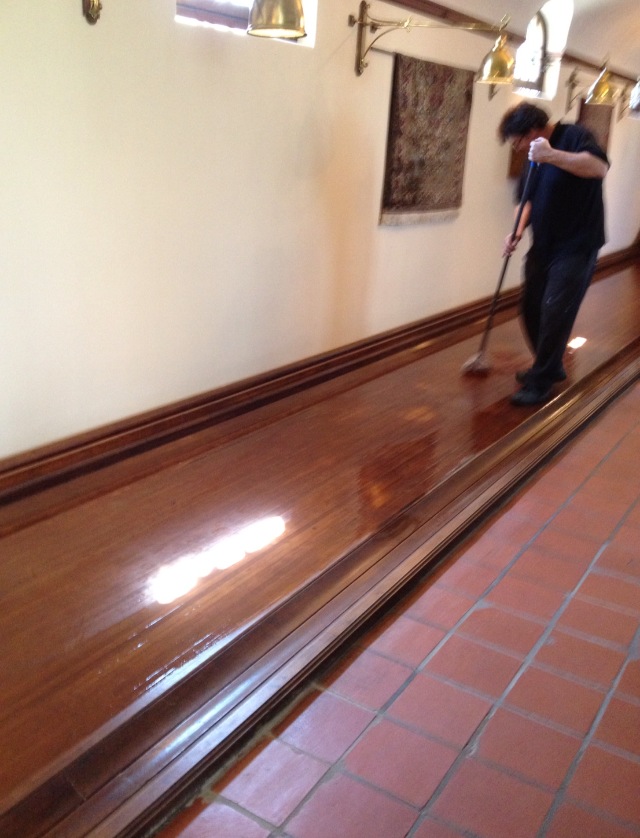
Over the years the Parkwood Bowling Alley has been used to store and exhibit examples of the carriages and cutters from the McLaughlin Carriage Company, as well as played host to the tour admissions desk and gift shop cash. Due to these multiple uses, including fifty five years of bowling games, the bowling lane was showing its age and some strong wear patterns.
Parkwood has previously worked with Mr.Sandless on several projects, including the Business Office and the Parkwood Lodge, and during one of his visits, Tom had suggested that Mr.Sandless could take a look at the Bowling Alley and assist with its preservation. Mr. Sandless was very aware that as a National Historic Site, some of the aging that resulted due to use during the family years, was precious to us, and the wear was authentic to our interpretation program, it tells the story of the McLaughlin Family at play.

The first step was the application of the wash solution. This very mild solution removed the surface dirts and grease. It also removed previous attempts at fixing with various stain applications over the decades. The wash solution application prepares the wood grain, enabling it to be ready to accept the next stage of the treatment.
The final step, between the drying cycles was the application of the varnish. After the renewal product was applied, most private households would have Mr. Sandless restore their wooden floors, with an application of stain. This was not the process of the bowling alley, because, remember those wear patterns that we love so much, the patina of historic use, Parkwood still wanted those. So, Tom, understanding our concerns and the need to keep the evidence of the alley being one of family use, followed our wishes and applied the varnish, as he is in the photo to the left.
Voila, the final product!
Thank you Mr.Sandless for a remarkable job on making the Bowling Alley gleam again!
![]() |
| www.mrsandless.com |
Friday, 8 February 2013
Conserving
the heritage landscape – Tree Management
Severe windstorms over the last six months have caused damage and destruction of aged trees at Parkwood. Grounds Foreman Brad Beer and Curator Samantha George recently grappled with various tree issues, and with the advice of City of Oshawa Forestry Supervisor Rob Fennell, have identified Parkwood’s TOP TEN TREE PROJECTS.
Parkwood has some incredible trees, many of which
were already here when Sam McLaughlin purchased the property in 1915 to build
his dream home. Working with top garden
designers over the next 20 years Sam and his wife Adelaide then planted many
more trees – to achieve the complex compositions and layered views we enjoy
today. Most have reached a venerable age
and beauty that you just can’t find elsewhere.
Sadly, like us, trees can age gracefully or quickly lose their looks and faculties, move into a slow or a rapid decline. The plug must be pulled at some point.
Trees are part of Parkwood’s overall heritage conservation,
an interesting and challenging process that includes:
Collections
Management & Curatorial
Trees are considered in the same way that the
mansion, furnishings and archives are - catalogued, monitored, with threats
identified and addressed if possible through conservation “spa” treatment. Trees are researched individually and as part
of the design, social and family histories of Parkwood, for interpretation and
educational purposes (eg. tree walks, garden tours, lectures, future virtual).
Evaluation/Assessment
Trees are assessed with regard to overall health and
appearance. Treatments are devised to
improve health and increase life-span (root feeding, pruning/thinning, cabling,
pest management)
Risk assessment is an important factor, to ensure
the safety of garden visitors, staff and volunteers.
Removal becomes necessary at some point, and planned
according to urgency and equipment access.
Late winter often provides the best opportunity for tree work, with
frozen ground and leafless trees.
Replacement
Research and site assessment is undertaken to
determine if replacement is desired or possible. Heritage conservation dictates replacing like
with like, which is always our preference but not always possible.
The replacement trees are chosen by species are
size, taking into account the location, season, time frame to do the work, and equipment
access (eg. tree spade or truck) and of course COST!
Site preparation is undertaken to provide the best
head start for new trees.
Funding Tree Management
It’s always a challenge to find the operating and
capital support needed, with so many heritage resources and competing
priorities at Parkwood. Effective tree
management requires a sustained effort, which isn’t always possible. Parkwood is grateful for individuals and
businesses who provide generous assistance.
Tribute/memorial
planting
Generally, Parkwood plants trees strictly within the
context of historic replacement. We
maintain lists of historic varieties/priorities for replacement, to respond to
donor requests to plant trees to mark occasions or in tribute/memorial.
Once in a while a unique opportunity arises. In 2011 Finance Minister Jim Flaherty and
Landscape Ontario planted a native maple tree, the first tree planted to mark
the first National Tree Day in
Canada. This took place in a
non-historic space (altered in the 1970’s for the parking garage), so was a
happy exception. Do try this at
home! The next National Tree Day is Sept
25, 2013.
Tree
Selection process
Parkwood adheres to landscape conservation principles
of the Standards and Guidelines for the
Conservation of Historic Places in Canada, which address land patterns,
landforms, spatial organization, vegetation, viewscapes, circulation, water
features, built features. Many of these
guide or inform tree replacement selection, to which factors we add Parkwood’s
particular history.
![]() |
| The Dunington Grubbs Landscape Architects |
Historic
& Design considerations:
·
What inspired the choice of species and placement originally?
·
What were the original design considerations,
characteristics and functions, we want to respect (eg. size and form within the
treescape, colour and texture of leaves & bark, intended to blend or
contrast with neighbouring trees)?
·
Was the tree a particular favourite of Sam or
Adelaide, a gift to them, planted to mark an anniversary or occasion?
Site
Conditions Then & Now
·
Are there site conditions that contributed to the failure/decline
of the tree (sunlight, moisture)? Can
they be remedied so that a replacement can flourish? If not, do we reconsider the replacement? Do
we delay replacement for years or decades?
·
Would you replace a Dutch Elm or other disease-prone
species?
Parkwood National Historic Site
TOP TEN TREE
PROJECTS
Parkwood
acknowledges with appreciation the advice of City of Oshawa Forestry Supervisor
Rob Fennell.
|
1. WHITE
SPRUCE
Location: North
End of Arbour
Action: Remove
to ground level and clean up/dispose of all brush
Replacement: Not advised at this time
|
Cost:$
2,000
|
|
2. SILVER
MAPLE
Location: South
Lawn, along Terrace
walkway
Action: Deadwood
prune and remove all stubs and hangers;
clean up/disposal
of all brush
|
Cost:$ 300
|
|
3. SIBERIAN
ELM
Location: 3 trees - Rose Garden, 2 trees – South Lawn
Action: Remove trees in Rose Garden to ground
level, clean up &
dispose of all brush, plant and stake new
Replacement:
80mm caliper Siberian Elm (3 to Rose Garden, 2 to South
Lawn, per previous
storm damage/removal)
|
Cost: removal
$6,000
replacements $ 1,000
|
|
4. SILVER
MAPLE
Location: Border
planting area along Simcoe Street fence
Action: Remove
to ground, clean up/dispose all brush
Replacement: Not advised at this time
|
Cost:$ 1,500
|
|
5. SCHWEDLAR
MAPLE
Location: South
Lawn
Action: Remove to ground, clean up/disposal, grind
stump
Replacement: 15’ to 18’ improved Schwedlar variety
|
Cost: removal $ 4,500
replacement
unknown
|
|
6. SILVER FIR
Location: Main
Entrance driveway
Action: Remove to ground, clean up/dispose of all
brush
Replacement: Not advised at this time
|
Cost: $ 300
|
|
7. BASSWOOD
Location: Main
Entrance driveway
Action: Remove old trunk to ground, clean up/dispose
of all brush
Replacement: Not advised at this time
|
Cost: $ 300
|
|
8. RED OAK
Location: South
Lawn
Action: Deadwood prune, clean up/disposal of all
brush
|
Cost: $ 700
|
|
9. CEDAR
& WHITE SPRUCE
Location: South
Lawn, east of Summer House
Action: Removal to ground, clean up/dispose of all brush
3 Cedars & 1 White Spruce
Replacement: Not advised at this time
|
Cost: $ 400
|
|
10. WEEPING
ASH
Location: South
Lawn
Action: Deadwood prune, clean up/dispose of all
brush
|
Cost: $300
|
|
TOTAL
ESTIMATED COST $ 17,300
|
|
Friday, 28 December 2012
Parkwood Volunteers 2012
I was counting up the hours of contributed volunteer time yesterday and although the year has not officially ended, the amount of time donated by our volunteer corps surpasses 10,000 hours. That's 10,000 hours of interpreting McLaughlin family history to the public; condition reporting and updating collections management records; cups of tea and scones served; special events organised and executed; walls washed and silver polished; floors waxed and buffed; gift shop merchandise priced; gardens weeded and watered and clocks wound and worked on. What amazes me is that these 10,000 hours are achieved with rarely a grumble and often a very vocal thank you to me for allowing people to volunteer at Parkwood and experience what a gem of Canadian heritage this National Historic Site is.
2012 was not without its challenges to the volunteer either. Much of our year and regular operation was disrupted by film production. Disruption that was welcome and sought by management, since those who follow our blog understand the financial necessity of filming at the site, but this limits the amount of time that I am able to dedicate to the important part of the volunteer experience, retention. Although the parking lot was filled with transport trucks, lighting cranes, generators and the mansion filled with equipment, 100 extra people, cardboard protection and mats, our volunteers rallied and continued to offer the best "experience" for the visiting public.
They perservered and met each Tuesday and Thursday for croquet matches, continued to attend their regular volunteer shifts, often parking off site, or arranging for drop offs and pick ups to avoid film crew vehicles, and even covered our reception duties when our small staff was pulled into the fray of film production hours and needs.
The volunteers embraced the creation and put up with the floundering Museum Morsels, our historic culinary club, now in full swing, but were patient as I slowly pulled it together despite overnight shifts, with on again, off again enthusiasm (on my part) for the project. Their attendance to our sessions, where we delved into food and social history (they all know my area of passion) reignited my personal interests and zest for the program amongst the craziness that surrounded us. Their combined excitement for the goals I established when I set out to create this program has generated a keenness among the corps that it is hard not to be caught up in their eagerness to experience food history.
Over the last few quiet days at Parkwood, I have been working on my volunteer programs, you remember, the retention pieces I neglected in 2012, and I am very energized about what 2013 will have in store for Parkwood NHS and the 160 dedicated volunteers we boast about with frequency.
2012 was not without its challenges to the volunteer either. Much of our year and regular operation was disrupted by film production. Disruption that was welcome and sought by management, since those who follow our blog understand the financial necessity of filming at the site, but this limits the amount of time that I am able to dedicate to the important part of the volunteer experience, retention. Although the parking lot was filled with transport trucks, lighting cranes, generators and the mansion filled with equipment, 100 extra people, cardboard protection and mats, our volunteers rallied and continued to offer the best "experience" for the visiting public.
They perservered and met each Tuesday and Thursday for croquet matches, continued to attend their regular volunteer shifts, often parking off site, or arranging for drop offs and pick ups to avoid film crew vehicles, and even covered our reception duties when our small staff was pulled into the fray of film production hours and needs.
The volunteers embraced the creation and put up with the floundering Museum Morsels, our historic culinary club, now in full swing, but were patient as I slowly pulled it together despite overnight shifts, with on again, off again enthusiasm (on my part) for the project. Their attendance to our sessions, where we delved into food and social history (they all know my area of passion) reignited my personal interests and zest for the program amongst the craziness that surrounded us. Their combined excitement for the goals I established when I set out to create this program has generated a keenness among the corps that it is hard not to be caught up in their eagerness to experience food history.Over the last few quiet days at Parkwood, I have been working on my volunteer programs, you remember, the retention pieces I neglected in 2012, and I am very energized about what 2013 will have in store for Parkwood NHS and the 160 dedicated volunteers we boast about with frequency.
Thursday, 23 August 2012
Canada's Garden Route Winners, Susan & Melissa at Parkwood
Parkwood welcomes Canada’s
Garden Route contest winners, Susan & Melissa.
Canada’s Garden Route
is a showcase of gardens coast to coast presented by VIA Rail. The route was recently promoted in an e-mail
contest with Scotts & Miracle Gro,
and the winners chose a Canadian garden journey aboard VIA over other international
garden offerings. And more exciting for
Parkwood, the winners selected our historic gardens (one of the 25 feature
gardens along the route) as one of five stops!
Winners Susan and Melissa experienced a sense of the lavish
lifestyle enjoyed by the family at this Canadian autobaron’s grand estate
during the inter-war years, and what it took to maintain it. Susan & Melissa sampled the worlds of
both the wealthy owners and the large house and garden staff: cutting fresh
flowers for the mansion; trimming up the mosaiculture beds in the Italian
Garden; lunching fountain-side at the Formal Garden teahouse; going behind the
scenes in the greenhouses and in the mansion; even meeting up with a crabby
cook and an errant parlormaid.
Thursday, 12 July 2012
Garden Voices of Ontario’s Historic Gardens
This is a new initiative organized for 2012 by Parkwood
National Historic Site. Prompted by interest expressed by participants at a 2011
historic gardens workshop at Parkwood, it was then organized with grant support
from the Ontario Ministry of Culture’s Cultural Strategic Initiatives Fund. Ontario Garden Tourism Coalition and National
Historic Sites Alliance for Ontario came on board as collaborative partners,
and a steering committee was formed with representatives from historic gardens,
tourism and related sectors.
Project Aims
We set out to tell the stories of Ontario’s historic
gardens, with enriched programs and experiences that would motivate Ontarians
to get out and explore them.
We knew a little about some of the recognized names associated with some of the garden designs, such as Dunington-Grubb and Olmstead, and we hoped to increase greater awareness of our design roots.
We considered a single week or timeframe to create an event
(such as Historic Gardens Week in Virginia), but from submissions we found that
best-viewing times and programming themes were too varied to bring together in
a single week.
We left it to each garden to devise its best showcase opportunity, and established a broader scope and a sort of umbrella theme for the project –
taking inspiration from the wonderful publication Garden Voices: Two Centuries of Canadian Garden Writing by Edwinna Von Baeyer and Pleasance Crawford. For in a sense, we can hear or experience the voices of the owners, designers, workers, and era influences that have shaped our historic gardens, in the physical evidence and in the animation of those voices through interpretation and programming.
The project received a lot of good feedback anecdotally from colleagues in the museum, garden and tourism communities. The project gave support to broader garden tourism initiatives, as a complimentary stream to other garden attractions, festivals & events generally, and as part of a build-up toward major international garden showcases in Ottawa and Niagara to mark Canada’s 150th in 2017.
The project was intended not only to increase awareness
about historic gardens, but also to increase visitation and visitor revenues,
attract volunteers and dollar support. Given
provincial investment and perceived interest of gardens and historic gardens as
“new” tourism offerings, the project was timely. Readiness of the gardens to participate was a
challenge however.
Project Results
Thirty-five historic gardens were identified, and grouped
together perhaps for the first time.
Eight feature gardens came forward with experiential offerings beyond
the standard fare.
The project prompted dialogue about what constituted a
historic garden or landscape. Notable 20th
century gardens for example are clearly preserved historic gardens, while many
other gardens would be considered recreations of gardens lost to time. For that matter, gardens we would call
historic are still on the drawing board.
Historic garden movements or practices also draw in cemeteries, forts,
railway gardens and parks, and merge with the broader idea of cultural
landscapes – all Intriguing and useful discussions.
More problematic were discussions about garden tourism,
particularly experiential tourism which calls for a much richer visitor
offering than the typical talk & point garden tour. As many owners or operators of historic
gardens do not speak “tourism”, we worked with Brain Trust Marketing &
Communications to develop a number of tools and materials. These can also be adapted to other projects
or used in future.
A new website was created, www.garden
voices.ca, to showcase the feature experiences and the rest of the
historic gardens. It too can be adapted for future use and linked to any
related historic, horticultural or tourism site. Other marketing efforts provided an
opportunity for gardens to maximize on their own budgets (eg. with
placements/publications not normally within reach of small organizations).
A number of difficulties encountered illustrate, in our
view, that historic gardens and landscapes need to be better understood and
supported. They are generally lacking in
resources, volunteers, and the will to present gardens as more than “second-fiddle”
to buildings & collections.
Programming is generally quite limited, and the historic garden voices are
often not well-articulated. Recreated gardens aspire to period-correctness and
authenticity but often lack resources for research, design and upkeep.
As project milestones
and submission dates approached, some gardens dropped out as feature garden
contenders, finding themselves unable to make the programming leap, or that
their gardens would not be up to scratch in terms of conserved state or event
basic maintenance. An additional
aggravation for some gardens was centralized budget, programming or marketing
controls that did not allow for decision-making at the site level.
We prefer to view this as not a sad state of affairs, but
rather as a new beginning for Ontario’s historic gardens and landscapes. Indeed, those gardens that declined to
participate as feature gardens were quick to add “this year”, adding their
pledge to resolve their readiness issues or other challenges in preparation for
next year, suggesting life beyond the project.
Subscribe to:
Posts (Atom)